A View from the Hubble Telescope
The human mind is not capable of grasping the Universe.
We are like a little child entering a huge library. The walls are covered to the ceilings
with books in many different tongues. The child knows that someone
must have written these books.
It does not know who or how. It does not understand the languages
in which they are written. But the child notes a definite plan
in the arrangement of the books
- a mysterious order which it does not comprehend,
but only dimly suspects.
--- Albert Einstein
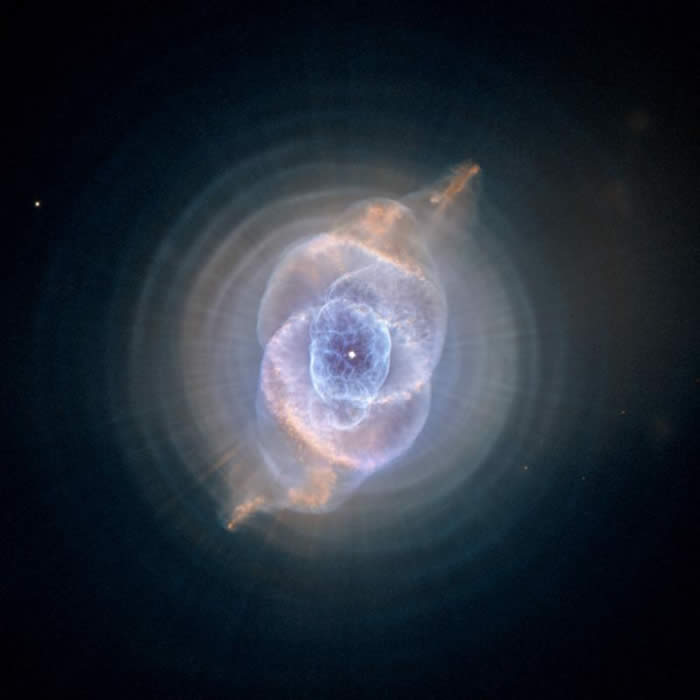
The Cat's Eye Nebula, one of the first planetary nebulae discovered, also has one of the most complex forms known to this kind of nebula. Eleven rings, or shells, of gas make up the Cat's Eye.
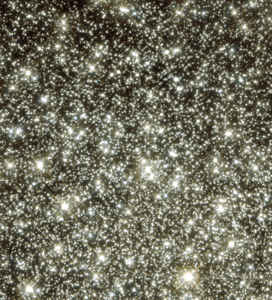
Inside Globular Cluster M22
ok...you asked where u r....
we as humans r lost in a vastness of
stars planets and other mysterys
beyond our
ability
"to know...."
worlds and worlds
we will never know a thing of....
and somehow
that just seemss
rite like star brite
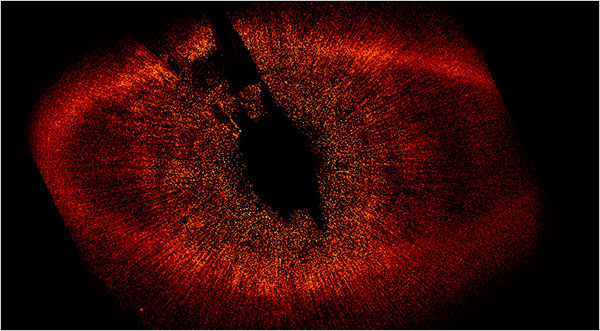
The most detailed visible light image ever taken of a narrow, dusty ring unequivocally shows the center is a whopping 1.4 billion miles away from the star; a distance nearly halfway across our solar system. The most plausible explanation is an unseen planet, moving in an elliptical orbit, is reshaping the ring with its gravitational pull. The geometrically striking ring, tilted toward Earth, would not have such a great offset if it were only being influenced by Fomalhaut's gravity.
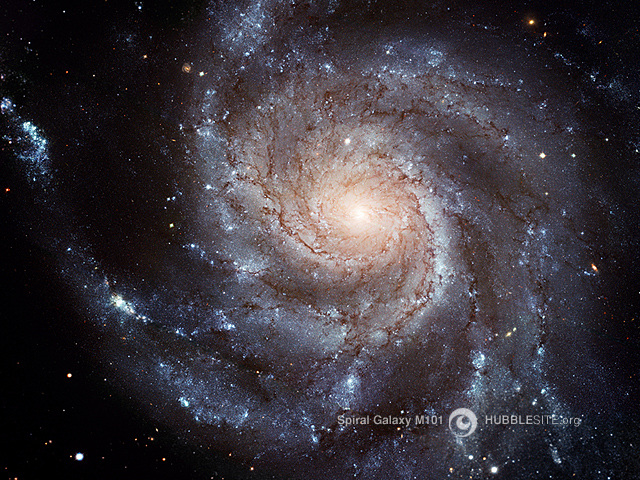
This striking spiral galaxy is home to a supernova, SN 2002fk, whose light reached Earth in September 2002. Astronomers are using that supernova to measure the expansion rate of the universe.
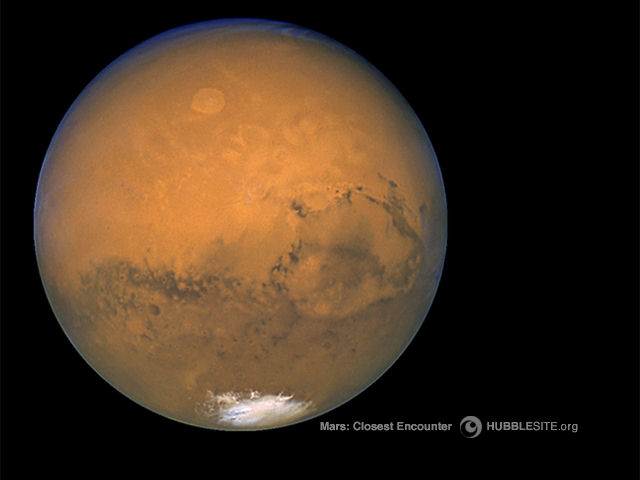
This image was taken within minutes of Mars' closest approach to Earth in 60,000 years, on Aug. 27, 2003. In this picture, the red planet is 34,647,420 miles (55,757,930 km) from Earth.
In questions of science the authority of a thousand is not worth the humble reasoning of a single individual. I do not feel obliged to believe that the same God who has endowed us with sense, reason, and intellect has intended us to forgo their use.
--- Galileo Galilei
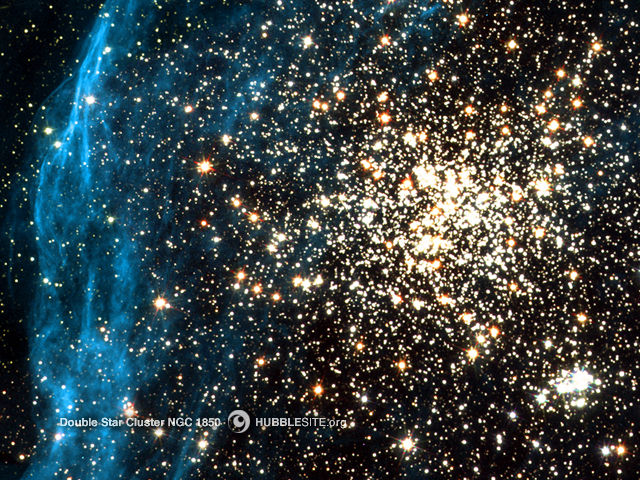
This "double cluster," NGC 1850, is located in the Large Magellanic Cloud. It consists of a large cluster of stars, located near a smaller cluster (below and to the right). The large cluster is 50 million years old; the other only 4 million years old. The cluster is surrounded by gas believed to be created by the explosion of massive stars.
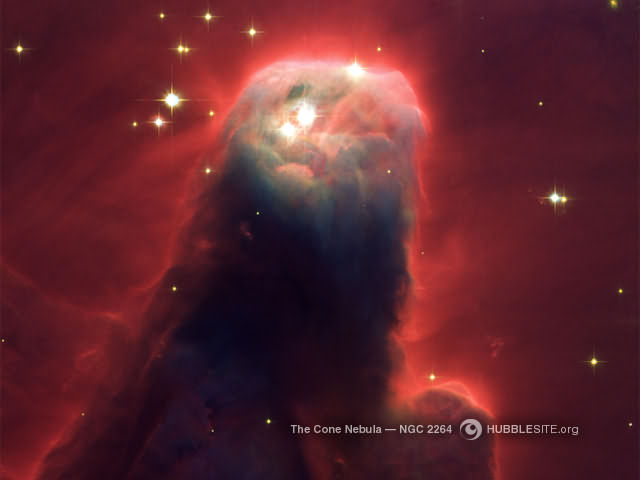
Radiation from hot stars off the top of the picture illuminates and erodes this giant, gaseous pillar. Additional ultraviolet radiation causes the gas to glow, giving the pillar its red halo of light.
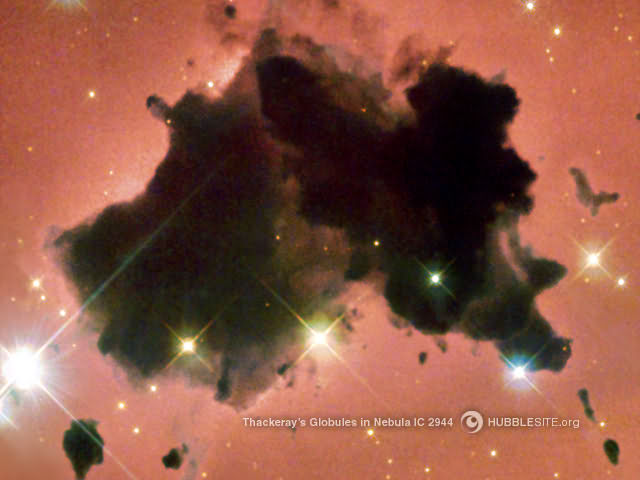
Dark clouds of dust, called globules, are silhouetted against nearby, bright stars. Little is known about the globules, except that they are generally associated with areas of star formation.
thanks to you Hubble Telescope...
eye have some milks and cookies hear...